The Red Decree – postscript

8 December 2025

It will soon be fifty years since I began to study the pre-modern Chinese materials in the Bodleian Library, during which time I’ve learned a little about everything and a lot about nothing. But that hasn’t prevented people from regarding me as an authority on the earliest acquisitions of Chinese books in Europe, the Yongle Dadian, the Red Decree, and much else. In fact only a few of days ago I was asked to speak about the Laud Rutter for a Chinese documentary on Diaoyu (the Senkaku Islands), an invitation which I had to decline: my knowledge of this subject, like all the others, goes no further than what is contained in my blog entry.

The same certainly goes for the Red Decree, of which I gave an account in my second blog entry, published over fourteen years ago in November 2011. But that notwithstanding, a couple of years ago my former colleague Cordula Gumbrecht (Staatsbibliothek zu Berlin – Preußischer Kulturbesitz) invited me to write a short essay on the Berlin copy of this remarkable document for the publication Sammellust und Wissensdrang : vier Jahrhunderte Asiatica in Berlin. [1] This beautifully produced volume contains accounts of forty-two of Berlin’s East Asian treasures, and its contents are also available online. I think it is essential reading for anyone with an interest in old Chinese books in general and the development of European collections in particular.

The three works in the Bibliography / Further Reading section of my contribution were provided by the editors. But in the same year as the Berlin volume was published, there appeared a substantial monograph on the Red Decree written by Sun Litian. [2] Last month, YS drew attention to Sun’s work in a comment on my original blog entry, but this was followed by a further comment from Manuel Sassman pointing to an excoriating review of it.

At the beginning of his preface, Sun reproduces my list of all the known surviving copies of the Red Decree. When both Sun and I were writing our respective contributions, these numbered eighteen. But in only a few weeks after our work had been submitted to the editors, in November 2023 a nineteenth copy was found by Chris Boobier in the Kent History and Library Centre in Maidstone. Of course I have been able to add this to my original blog entry, but unfortunately the published lists are already out of date. Perhaps (like the 17th-century acquisitions), even more copies are awaiting discovery.


1. Sammellust und Wissensdrang : vier Jahrhunderte Asiatica in Berlin = A passion for collecting, a thirst for knowledge : four centuries of asiatica in Berlin / herausgegeben von Achim Bonte. – [Berlin] : Staatsbibliothek zu Berlin – Preußischer Kulturbesitz, 2024. – (Beiträge aus der Staatsbibliothek zu Berlin – Preussischer Kulturbesitz ; Band 53). – 200 p. ; 22 x 30cm. – ISBN 978-3-88053-223-6
2. 康熙的红票 : 全球化中的清朝 / 孙立天著. – 北京 : 商务印书馆, 2024. – 精裝1冊(383頁) ; 22公分. – ISBN 978-7-100-23424-5

An astrological calendar

2 March 2025

I’m not sure if it’s good (or at least acceptable) practice to rename and rewrite blog entries that have already been published, but I’ve just done so. So much information about the Stuttgart calendar came to light following my original posting that I’ve decided to rewrite my account of it and give it its own new entry, removing it from my previous entry which is now only concerned with the recently discovered Shuihu fragment.

The story began in November 2023, when Marcel Thoms, Head of Acquisitions & Cataloguing at the Württembergische Landesbibliothek told me about a calendar that had been discovered by accident while the Library was preparing an exhibition on time division. Although there is no absolute guarantee that the calendar came to Europe in the 17th century, in its subject matter and physical appearance it is of a piece with the rest of what I call the “seventeenth-century corpus”, and Marcel has told me that its shelfmark (Cod. or. 4° 4, especially the low number 4), indicates that it was part of the founding collection of the Library’s predecessor, the Herzogliche Öffentliche Bibliothek. This had been founded in Ludwigsburg in 1765 by Duke Carl Eugen (and most unusually it was open to the public from the start, as its name suggests). At that time it would have been quite normal for figures such as Duke Carl to have possessed a fragment of one of the Chinese books that came to Europe in the 17th century, as a glance at my list will confirm.

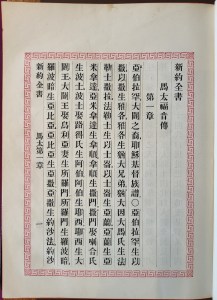
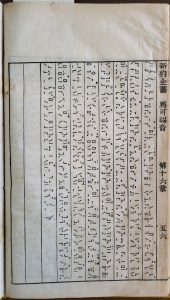
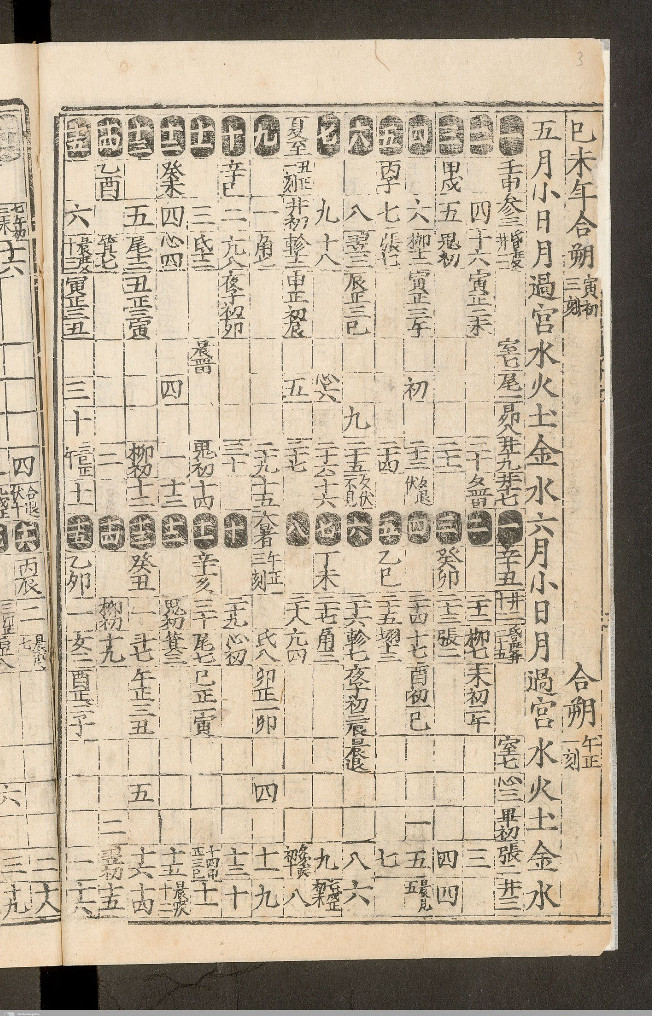
The Stuttgart volume is only a fragment of the complete work, whose full extent is unknown. The surviving leaves are all from juan 卷 7: 2-60上 (the first and last of these leaves are badly damaged in the area of the banxin 版心) and cover the years 1559-1568 (嘉靖己未年一、二月~嘉靖戊辰年三、四月). Here is the front cover and a specimen page from the calendar, which has been digitised:

I had no clear idea of why calendars of the lucky days in years gone by should have been published, so again I went to my friend Zheng Cheng 郑诚, who as expected told me exactly why. They were produced to enable fortune-tellers to calculate the best date for marriages, funerals, or other important events on the basis of the subjects’ birthday information; that is, their shengchen bazi 生辰八字, or “eight birthday characters”, namely the year, month, date, and hour of their birth each expressed in two characters from the sexagenary “heavenly stems and branches” (干支) system. Although people would remember these dates, they would not know the astrological details associated with them.

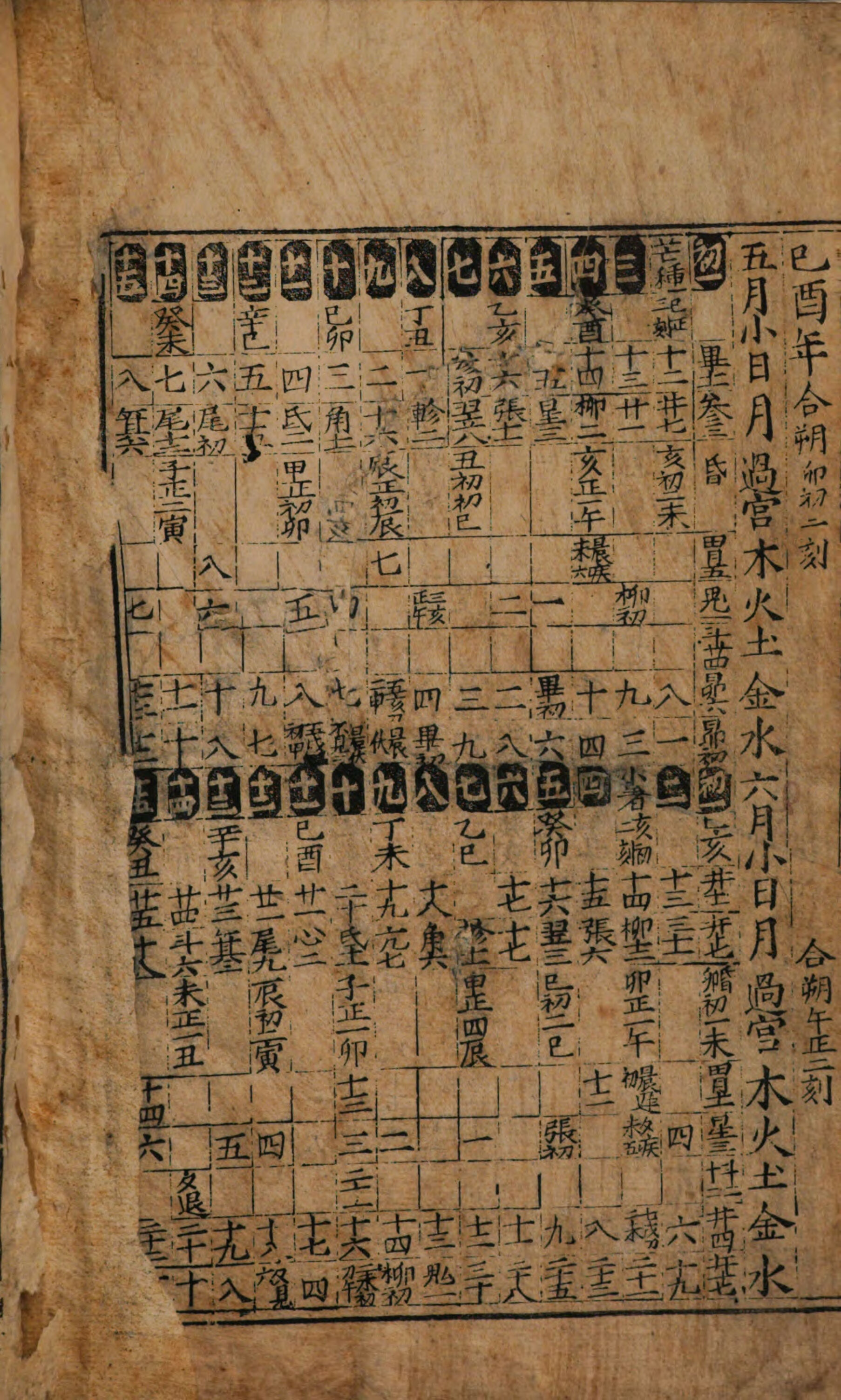
Pursuing his enquiries, Zheng Cheng got in touch with the scholar Zhao Jianghong 赵江红 who has written a number of articles on the subject, and she informed him that there is another fragment of the same copy of this calendar in the Österreichische Nationalbibliothek (shelfmarked Sin 133-C ALT SIN). This fragment has also been digitised. It contains most of juan 卷 6 (unfortunately the pagination is not visible in the digitisation) covering the years 1549-1558 (嘉靖己酉年五、六月~嘉靖戊午年十二月), and most importantly the first half-leaf of juan 卷 7, which is missing in the Stuttgart fragment.

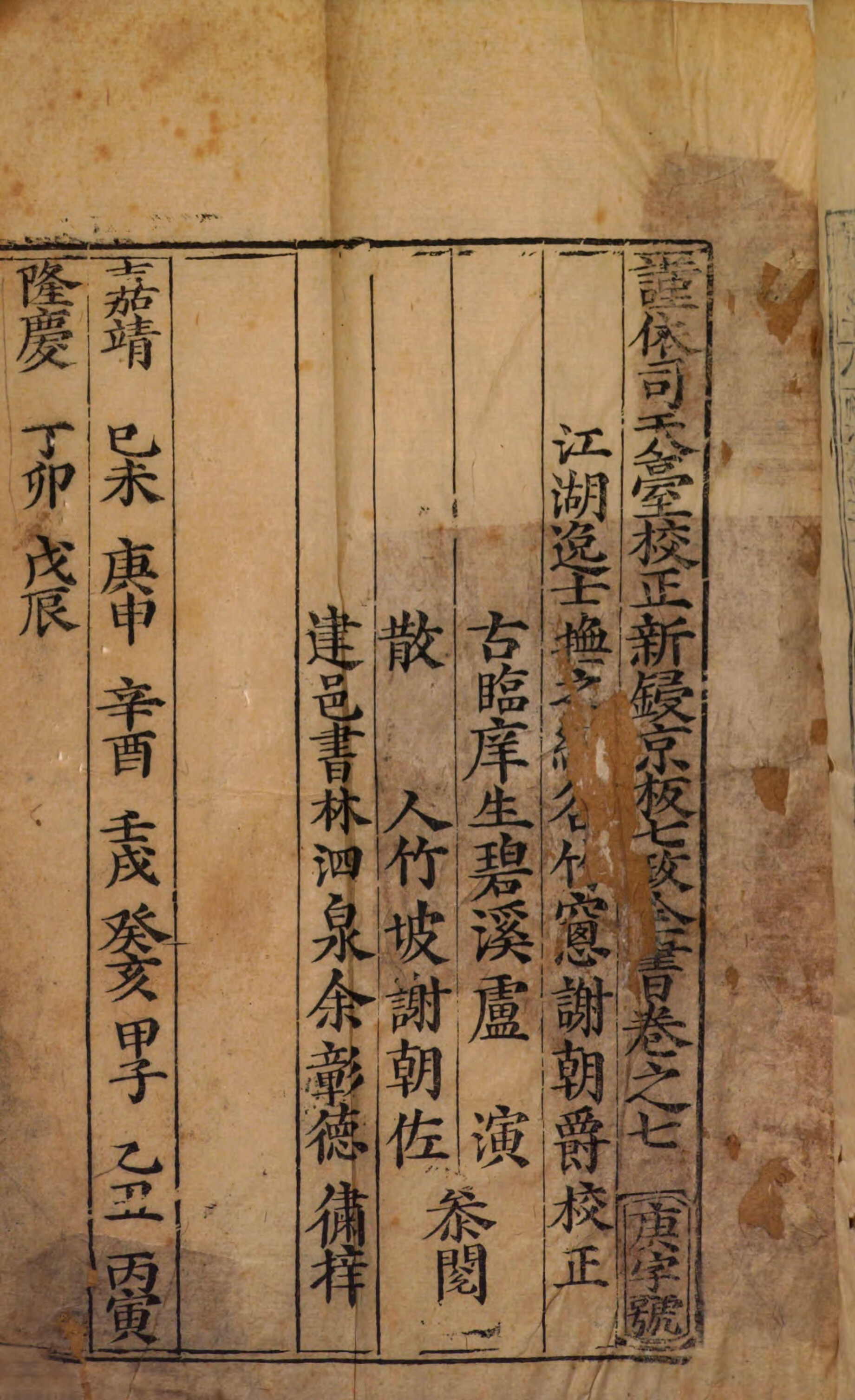
Not only does this indicate that the Vienna and Stuttgart fragments are consecutive parts of the same copy, but it also provides us with an exact title for the work as well as other bibliographical details.

So the title of the work is 《謹依司天臺校正新鋟京板七政全書》 jin yi si tian tai jiao zheng xin qin jing ban qi zheng quan shu, and it was edited by 謝朝爵 Xie Chaojue and published by 余彰德 Yu Zhangde, a member of the famous Yu family of Jianyang 建陽 publishers, making the edition of a piece with other parts if the 17th century European corpus.

When I originally posted my account of this calendar I had already learned from Zheng Cheng that the qizheng 七政 referred to in the title are the “seven ruling powers” (for want of a better translation) of the Sun, Moon, Jupiter, Mars, Venus, Mercury, and Saturn, which are all used in astrology and prognostication. But I had no idea of how the calendar was structured until Edward White posted a very informative comment, as follows:

“The page of the Stuttgart calendar you showed [and presumably this also applies to the page from the Vienna fragment] is a tabulation of the places of the planets in the sky. The top half of the page shows the data for the 6th month, and the bottom for the 7th. Each column represents a day of the month, and each row shows (from top to bottom):

1- The date of the month (in white on black lettering)
2- The sexagenary cycle of the day
3- The sun’s position
4- The moon’s position
5- The time of day the moon changes zodiac sign
6- Jupiter’s position: (水 is probably an error for 木)
7- Mars’ position (Mars seems to be in retrograde motion in this period, that’s why the numbers go backwards)
8- Saturn’s position
9- Venus’ position
10-Mercury’s position

All the positions from 3-10 (except 4) are stated in terms of the 28 lunar mansions or 宿. Additionally, it seems publishers only noted the days when the planet moved a degree and did not provide entries for the intermediate days. This is especially apparent in the rows of the slow-moving planets Mars, Jupiter and Saturn.”

In a subsequent e-mail message, Edward also points out that in addition to the “Seven Governors” 七政, the almanac also tabulates the “Four Remainders” 四餘. These are four mathematically determined points which are also considered significant in astrology: Ziqi 紫炁, Yuebei 月孛, Rahu 羅㬋 and Ketu 計都, the last two being adapted from Indian astrology. The positions of these points are tabulated in the final columns of each month in both the Stuttgart and Vienna fragments; their names are abbreviated to 炁、孛、羅、計.

Zheng Cheng has located a few similar calendars in Japan, one in the Fu Ssu-nian Library 傅斯年圖書館 in Taipei, and one in the Palace Museum Library in Beijing. This last one is presented in almost exactly the same format as the Stuttgart edition, and has been reproduced twice:
1. 续修四库全书, 第1040册 (上海: 上海古籍出版社, [1996])
2. 故宫珍本丛刊, 第388册 (海口: 海南出版社, 2000)

Both the Palace Museum edition and all the others have later date ranges than the edition in Vienna and Stuttgart, which might well be the earliest in existence.

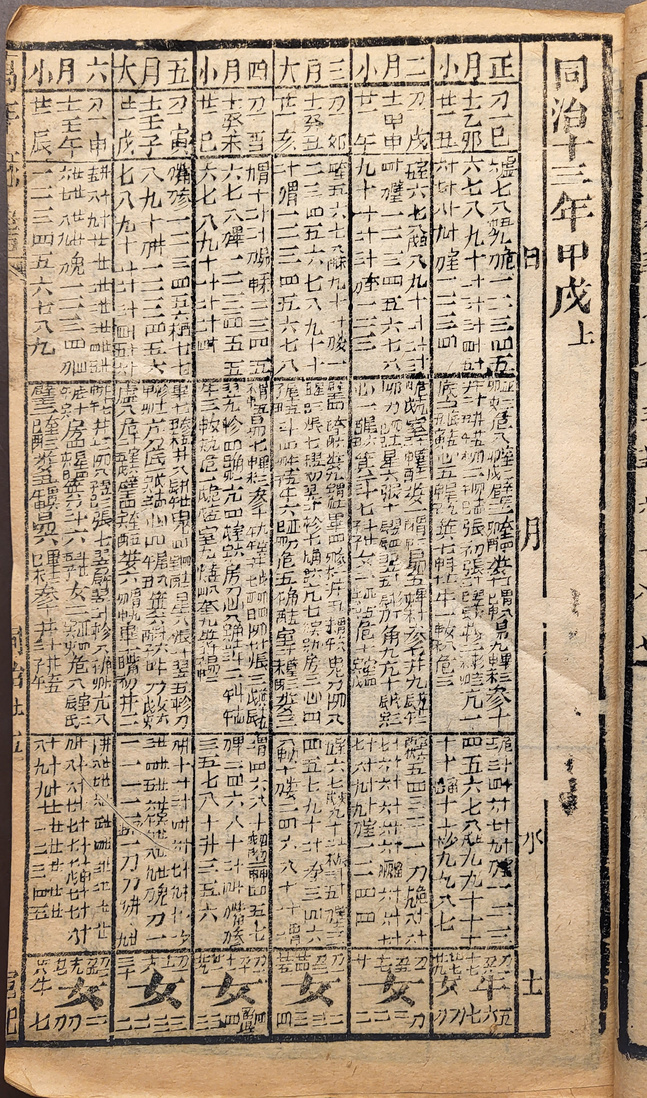
There are later, even relatively modern examples of this type of calendar, and there is one in the Bodleian which I bought in Yamada Shoten in Tokyo in 1981:

重訂七政臺歷萬年書 : 不分卷 / (清)欽天監修
民國十二年[1923]富記書局刊本
線裝1冊 ; 25公分
同治十三年甲戌[1874]至光緒三十四年戊申[1908]
Sinica 2666

Of this, Edward White says:

“The 重訂七政臺歷萬年書 is published in an even more compact format. In the case of the Sun, Moon and Mercury The publishers dispensed with numbering the days individually, and instead formatted the entries for each month as a 10×3 grid; the reader was expected to find the relevant data for a given date based on its position in the grid. (eg: the 5th box of the right column of the grid = 5th day of the month). The bottommost row shows the dates Saturn changes degree.

I should also note that some modern Chinese almanacs still publish the planetary coordinates: Examples include 正福堂、繼福堂、真步堂.”


Another Shuihu fragment

31 January 2025

This is my eleventh blog entry on the subject of the Chinese books that came to Europe in the 17th century. I have now tagged them all as “17th century accessions” (in the “Categories” list at the bottom left of the screen) so that they can be conveniently located. As indicated in my last entry on this subject, which I’m astonished to see was written over four years ago, if I can I like to say more about them than it would be appropriate to put in my simple list. And as in this entry, that often amounts to little more than repeating what others have told me.

Two recent finds are of unusual interest, and both involve Stuttgart in one way or another. I will deal with them separately in this and my next blog entry.

When books that came to Europe in the seventeenth century are discovered, they are usually found in older libraries where they have often lain unidentified for centuries, or in newer libraries that house older collections. Of all the places that one might look for them, China would be the last.

Yet the latest discovery was indeed made in China. It was brought to my attention by Zheng Cheng, who e-mailed me in August last year to say that while reading an issue of Huaxi yuwen xuekan 华西语文学刊 he had come across an article by the scholar Ai Junchuan 艾俊川 in which he reproduces, with a very informative introduction, 23 half-leaves from an edition of the Shuihuzhuan 水滸傳 which he bought from an English dealer on eBay in December 2007 for the sum of £26. [1]

In his article, Ai establishes that the half-leaves in his possession are not only from the same edition, but from the same copy of the well-known fragments preserved elsewhere, as documented in my list. It is extraordinary that this is the second fragement of that copy to have been found on eBay – I documented the discovery of the earlier, much larger one in my blog entry of November 2020.

Furthermore, Ai has also established that they dovetail precisely with not only the missing leaves, but also the missing half-leaves of the Stuttgart fragment. Unfortunately owing to the trimming, the pagination of these half-leaves is missing, but on the basis of their content, it should be possible for someone with a detailed knowledge of the Shuihu text to figure it out.

The reason why I’m referring to “half-leaves” is because a previous owner has cut the two panels of text out of each leaf (sacrificing the banxin 版心 in the process), and mounted them individually as shown in this image, which Ai Junchuan has very kindly sent me:

This is the first half-leaf of juan 卷 3; for comparison, here is the first half-leaf of juan 卷 4 in the Stuttgart copy:

Although I first encountered the single leaf preserved in the Bodleian (Sinica 121) almost fifty years ago, I never took the trouble to find out exactly what it is, and why it is significant. In fact I didn’t even know that there is no standard version of the Shuihuzhuan despite its status as one of the “four great works” 四大名著 of Chinese fiction.

Ma Youyuan 馬幼垣 has written two lengthy monographs on its extraordinarly complicated textual history [2]. There are many quite different versions which fall into two groups, “complex” 繁 and “simple” 簡; the “simple” versions narrate the events in less detail, and are intended for less sophisticated readers. And whether simple or complex, some editions may be “augmented by the insertion of the tales of Tian Hu and Wang Qing” 插增田虎王慶.

As indicated by its title 《新刻京本全像插增田虎王慶忠義水滸全傳》 the European fragments are from a copy of the “augmented” version, which is also “simple”. In fact it is believed to be the earliest extant example of such an edition.


1. 艾俊川: 从欧洲回流的插增本《水浒传》残叶 (华西语文学刊第十一辑, 2015, 217-226); the article can also be found here.
2. 水滸論衡 (台北: 聯經出版事業公司, 1992, ISBN 957-08-0794-6); 水滸二論 (台北: 聯經出版事業公司, 2005, ISBN 957-08-2887-0).

Chinese Bibles

30 November 2024

When I made my first posting to this blog in November 2011, I described it as the waizhuan 外傳 (“outer chapter”) to the neizhuan 內傳 (“inner chapter”) of the Serica Project, whose aim was to locate, identify, and list all the pre-modern Chinese materials in the Bodleian and other Oxford libraries; it was designed to answer the question that library catalogues can’t, that is, what have you got. (The “inner chapters” in Chinese thinking are the official, orthodox accounts; the “outer chapters” are where writers express their own freer accounts, untrammelled by convention.)

At an early stage of the project the Library offered to host the blog on its own server. I declined the invitation for reasons which will soon become apparent.

The Serica Project: its current state

The Serica Project had been primed by a generous donation from Nicholas Coulson, following which further substantial funding was obtained from the Tan Chin Tuan foundation in Singapore. By the time of my dismissal at the end of September 2017, although I had not only fulfilled but substantially exceeded what had been required of me under the terms of the funding, much work remained to be done. So in time-honoured fashion I continued to work on my project in retirement. Between then and the time the allegro catalogue was closed at the end of February 2020, I had added a further 6376 records to the database, mostly the contents of the collectanea (congshu 叢書) that Joshua Seufert had transferred from the China Centre Library before going to Princeton in 2018.

What I had failed to realise is that times had changed. Working on the Library’s collections in retirement was now not only discouraged, but was soon not even to be tolerated. My first intimation of this came from Bodley’s Librarian’s deputy, now in charge of her own university library, who told me to forget everything I ever knew about my subject and spend more time with my grandchildren. I got the impression that she considered a librarian whose interest in his work persisted after he ceased to be paid for it must be mentally ill.

The final blow came in November 2021, when the Library suspended the updating of the Serica database without a word of warning or explanation either to me, the wider academic community, or the donors. I simply discovered one day that I could no longer upload a quantity of new work. My access to the server had been terminated.

The Serica database however continued to be accessible on the Library’s website until last month (October 2024), but only as a crippled relic of its former self: incomplete, occasionally inaccurate, and failing to give access to everything that has now been digitised. Moreover, the specimen pages (shuying 書影), invaluable to Chinese bibliographers and numbering several thousand, had for some reason been discarded in their entirety.

One wonders what sort of library it is that receives over a quarter of a million pounds to set up a bibliographical research tool one minute, and then trashes it the next.

Fortunately, I had long been acting on the advice of a colleague to download everything I could from the servers to which I had access before I became the inevitable victim of managerial high-handedness. This I did regularly, backing up my work after every session, so that with my limited programming knowledge I have been able to recreate a simplified but workable version of Serica and its infrastructure on my own server, which is now safely out of harm’s way. I’m thus able to continue working towards the completion of the project (and in doing so, honour the generosity of the donors), and this account of the Bodleian’s collection of Chinese Bibles is another step on the way.

The Bodleian’s Chinese Bible collection

Until I completed my listing of our Bibles just over a year ago, I had only catalogued the editions with Sinica shelfmarks. I had lost sight of more than two hundred editions in the Library’s classified collection, which was the work of Edward Williams Byron Nicholson (1849-1912) who was Bodley’s Librarian from 1882 until his death in 1912. [1]

Nicholson devised his classification during the very first year of his appointment, and it was implemented immediately in 1883. His scheme was numerical, and evolved from earlier schemes that had been in use in the Library since the time of its foundation. [2] Although it remained in use for over a century, it is surprisingly ill documented. The fullest description known to me is that of Michael Heaney [3], but Heaney makes no mention of the non-numerical part of the scheme which was used for Oriental materials (shelfmarked Arab., Chin., Heb., Jap., &c.), nor the shelfmarks used for the classification of Judaeo-Christian scriptures (Bib., O.T., N.T., Ps., followed by a language designation). Both the numerical and non-numerical designations in Nicholson’s scheme are followed by a letter denoting the physical height of the item (to make the most economical use of shelfspace), and then a running number. It is worth noting that when the New Library was built in the 1930s, the shelving was designed to accommodate this sizing.

The Bibles in the Sinica collection are for the most part those that were acquired before the inception of the Nicholson classification in 1883. There are 121 editions, most of which are not complete Bibles, but single books or groups of books.

The Bibles acquired after 1883 were given Nicholson shelfmarks as listed here. There are 228 editions. Working from the handlists, just over a year ago I was able to take stock of everything we have, and to catalogue it.

There are a further 33 editions in Regents Park College, so that in total I have so far discovered 333 different Chinese editions of the Bible (or parts of it) of in Oxford libraries. There are listed here, as well as under their classified place in the Serica website (西人著書 耶穌教 聖書). Inevitably there is some duplication, so that the number of copies is rather higher. Also, it is quite likely that more Bibles will be found in other Oxford libraries.

Other collections

The largest collection of Bibles in the world is believed to be that of the Bible Society (formerly known as the British and Foreign Bible Society) which was transferred to Cambridge University Library when the Society sold its premises in central London (146 Queen Victoria Street) in 1985. I referred to this in an earlier blog entry which has some relevance here. When the collection was catalogued by Darlow and Moule in 1911, it contained 568 Chinese editions, numbered 2452-3019. [4] By 1975 the collection had grown to over one thousand editions, and was the subject of a second printed catalogue compiled by Hubert Spillett [5], who had worked for the Baptist Missionary Society from 1930 until his retirement in 1967. Spillett re-numbered the Bibles 1-1091, 1-568 being Darlow & Moule’s 2452-3019. The collection is now listed online here.

Of course there was already a collection of Chinese Bibles in Cambridge before the acquisition of the Bible Society’s library, but it was small, numbering only 64 editions. Yan He, the Library’s Chinese specialist, has very kindly sent me a list of them.

Clearly the Cambridge collection is by far the larger, and may possibly be the largest collection of Chinese Bibles in existence. But this is mostly because it contains a much greater number of twentieth-century editions. For the study of Chinese Bible translation in its nineteenth-century heyday, the Oxford and Cambridge collections are of similar size and value.

Many of the Bibles in both the Oxford and Cambridge collections came from two of the great nineteenth-century international exhibitions: the Centennial Exhibition of 1876 in Philadelphia (these books probably reached us through the agency of Alexander Wylie), and the International Health Exhibition of 1884 in London. I discussed this matter in some detail in a paper I presented in 1988 at a conference in Taipei, and have just revised it, mostly because of its relevance to this blog entry. It can be seen here.

Cataloguing

Spillett’s catalogue follows the pattern of Darlow & Moule’s, and is descriptive. My list conforms with standard library cataloguing rules, where possible reproducing bibliographic information as it appears on the book, and expressed in ISBD (International Standard Book Description) format. Here are examples of the same entry from each of the catalogues:


Darlow & Moule
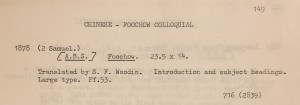

Spillet
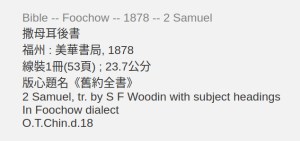

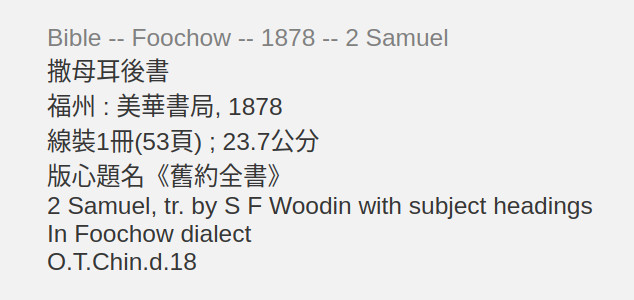
Serica Project

A few words of explanation are necessary.

I have used the headings and filing order of the two Bible Society catalogues, so that the word “Bible” (not necessary in their case, as the catalogues are of Bibles only) is followed by the language (usually called “dialects” in Chinese, even when they are mutually unintelligible), then the date, then the part of the Bible where necessary: it usually is, as most editions are not of complete Bibles. I have used the 19th-century spellings of the dialects and place names (Foochow, Amoy, &c) not out of antiquarianism, but to be consistent with the two existing published catalogues and the usage in all contemporary documentation.

The Bibles, like all the other missionary publications, present cataloguing problems as they are neither Chinese nor English, but hybrid in both form and content. Unlike traditional Chinese publications, in which what appear to be title-pages are no such thing (see section 3 of this blog entry), in the missionary publications, which were written and printed by foreigners, they really are title-pages of the western type and as such are what cataloguers call the “principal source of information”. And as the publications are usually more western than Chinese in presentation, I have expressed the imprints not as a single sentence of classical Chinese, but with the more familiar ISBD punctuation: “place : publisher, date”. Also, the cataloguing language in the Serica Project is Chinese, but again the normal rules simply can’t be applied. Just as the English translation of the note 「版心題名《舊約全書》」 is long and inelegant, so the English “2 Samuel, tr. by S F Woodin” makes little sense in Chinese except to the initiate. So my cataloguing language is mixed.

And when noting the version of the Bibles, if the names of the translators don’t appear on the publication, which is usually the case, I’ve reproduced the information given by Spillett uncritically, having neither the energy, the ability, or the means to work it out for myself. In the case of romanised translations, I’ve ignored the accents altogether, as some of them are so bizarre that I doubt if they’re even encoded.

My records are therefore a bit of a mess, and I don’t know what to do about it. At least they’re better than nothing. It has taken nearly 150 years to get this far; perhaps it will take another 150 years for the Library to do the job properly. As things are, the only way to find out what we’ve got is to look at my list.

A few bright spots

Cataloguing our Bibles was on the whole a rather boring task, but during the course of the work, there were a few bright spots. Here are some of them.

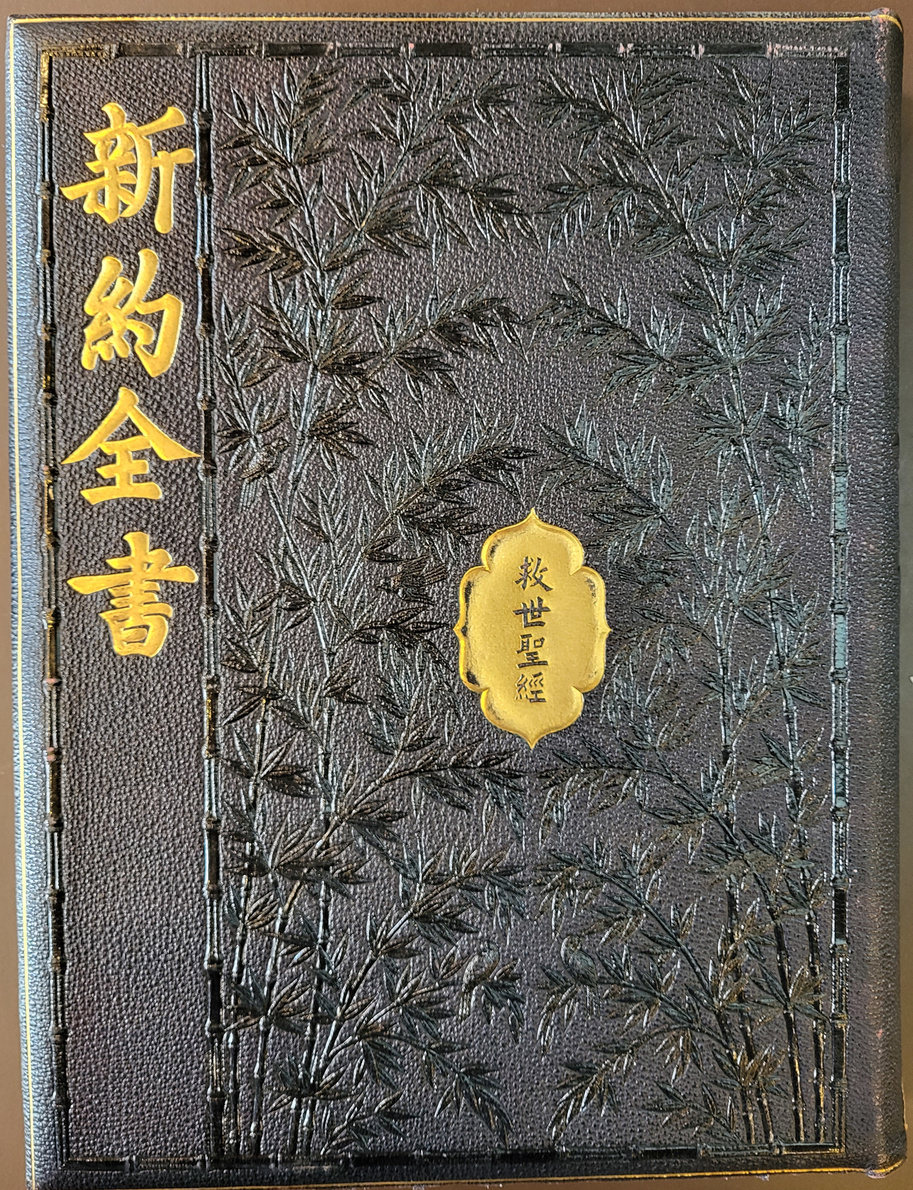
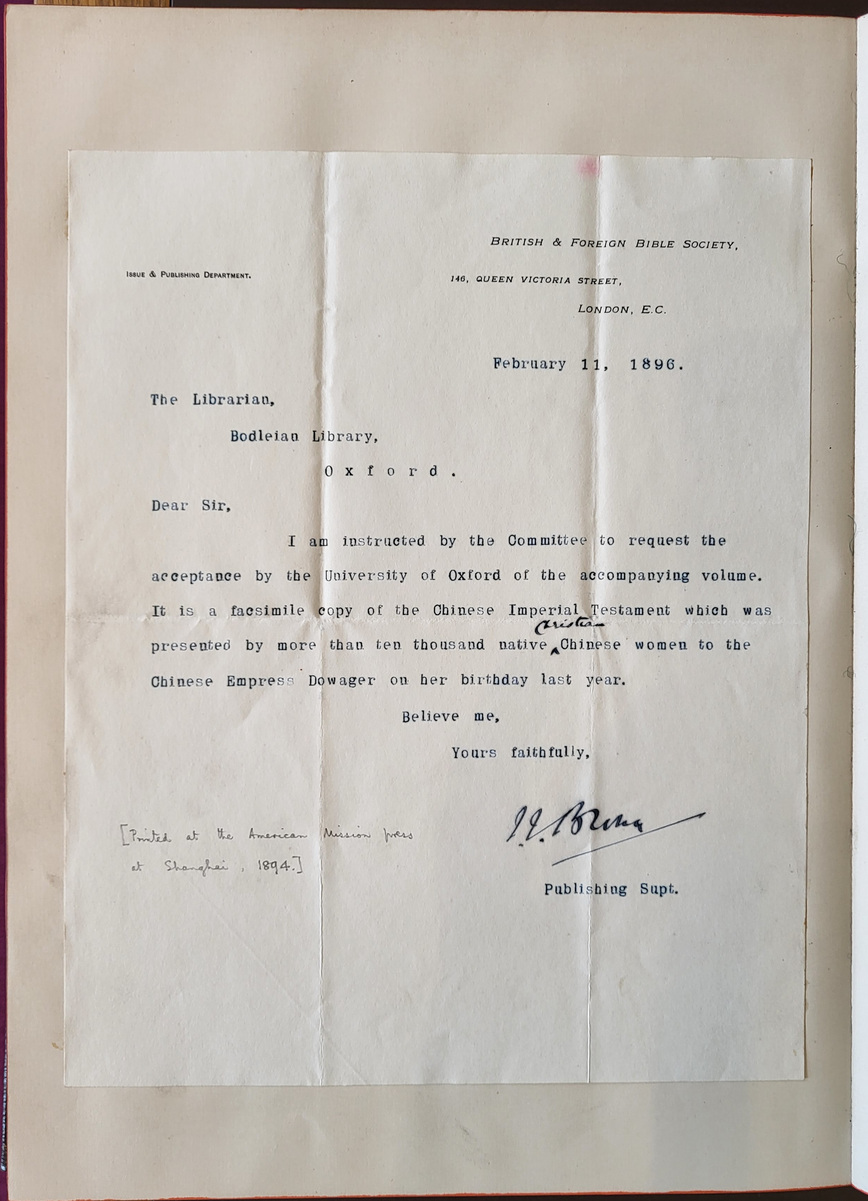
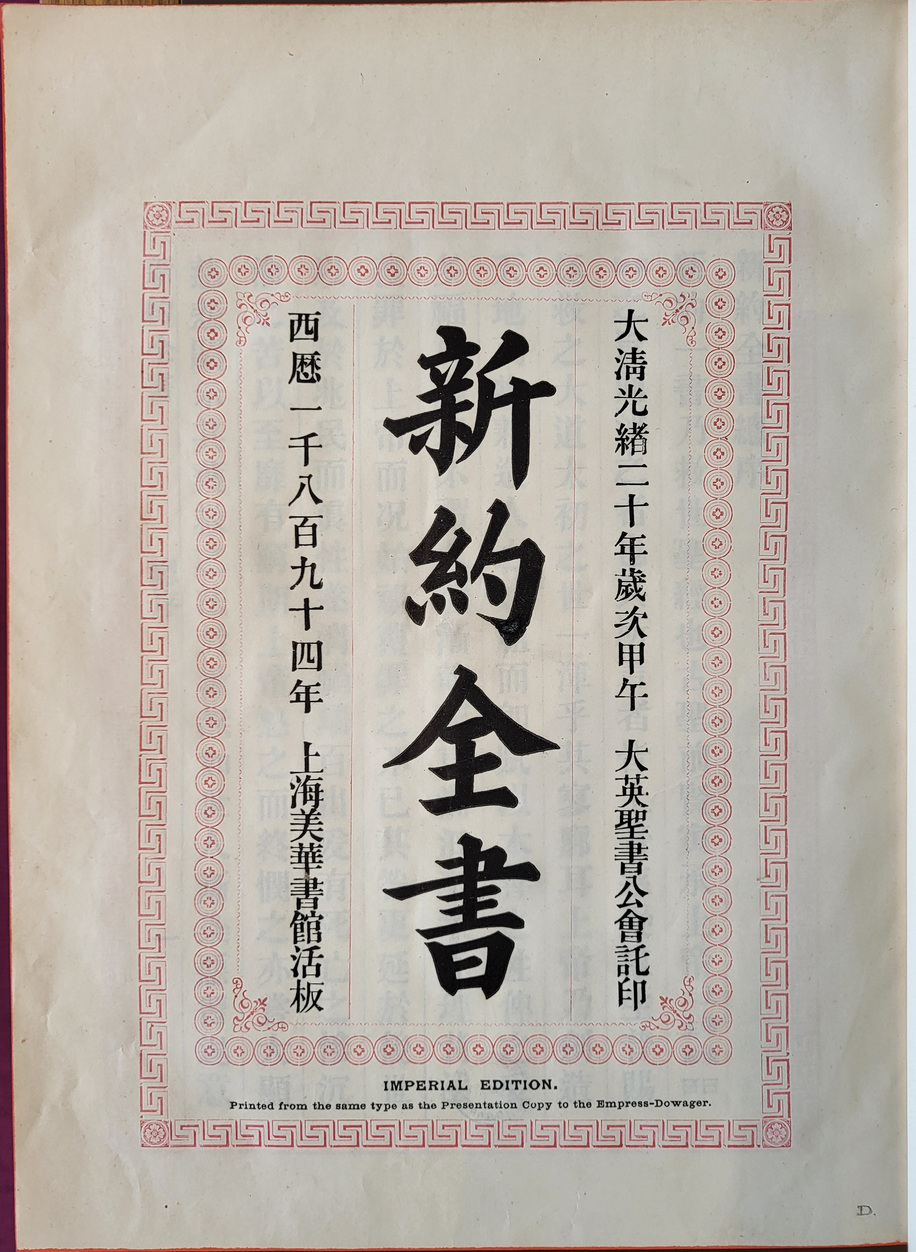
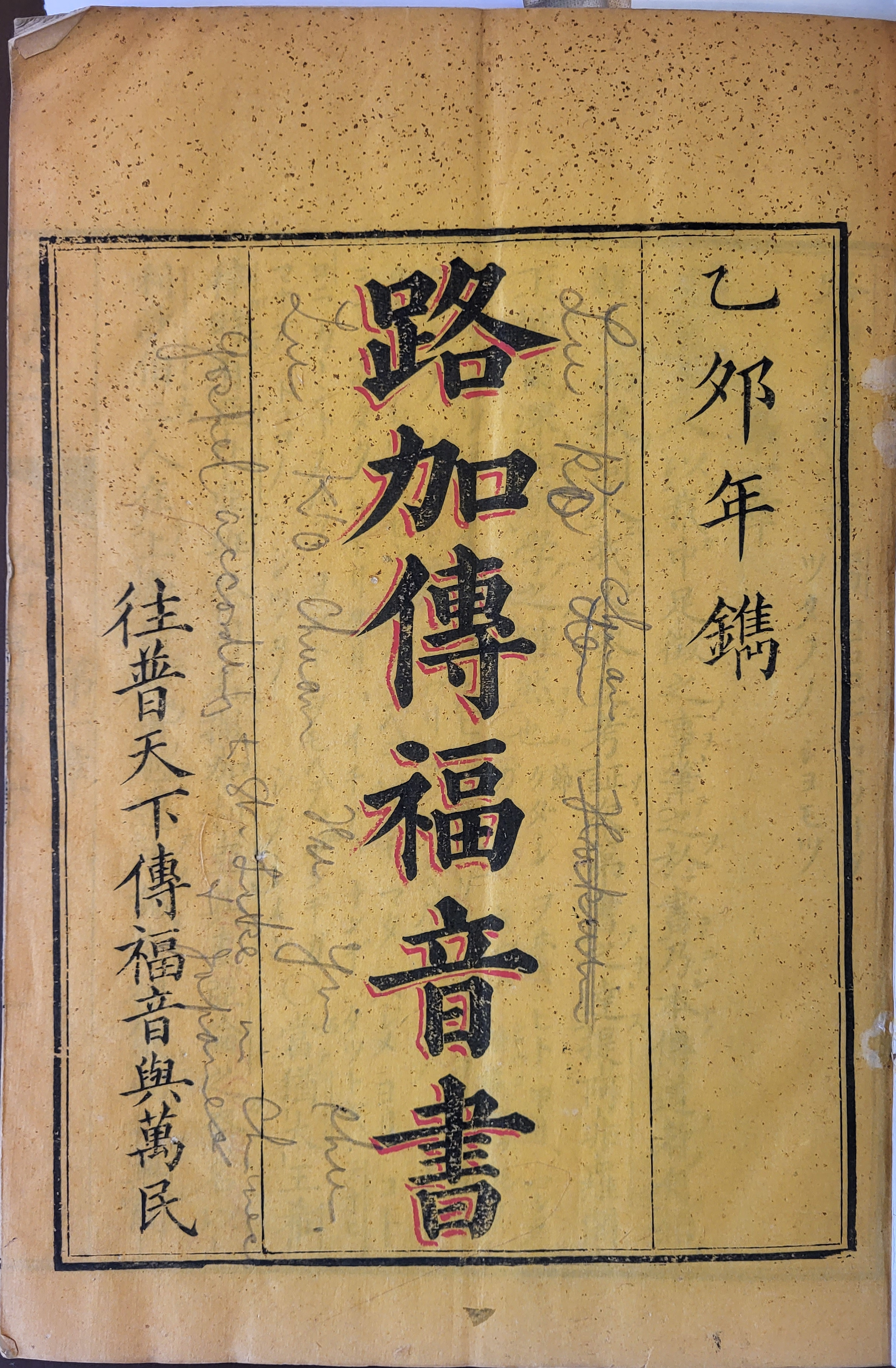
This is perhaps the most luxurious Chinese edition of the Bible ever produced. It is the New Testament which as the accompanying letter explains was presented to the Empress Dowager on the occasion of her birthday by a group of over 10,000 Chinese Christian women in 1894:
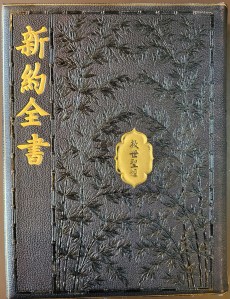
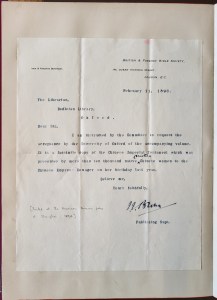
N.T.Chin.c.1

John Lai was a doctoral student in Oxford in the earlier years of my curatorship and now has a chair in the Chinese University of Hong Kong and is an authority on Chinese missionary translation work. He has confirmed my suspicion that the scriptures which the missionaries translated into Chinese dialects, usually in romanisation, are almost certainly the most substantial, if not the only examples we have of these dialects as spoken in previous centuries.

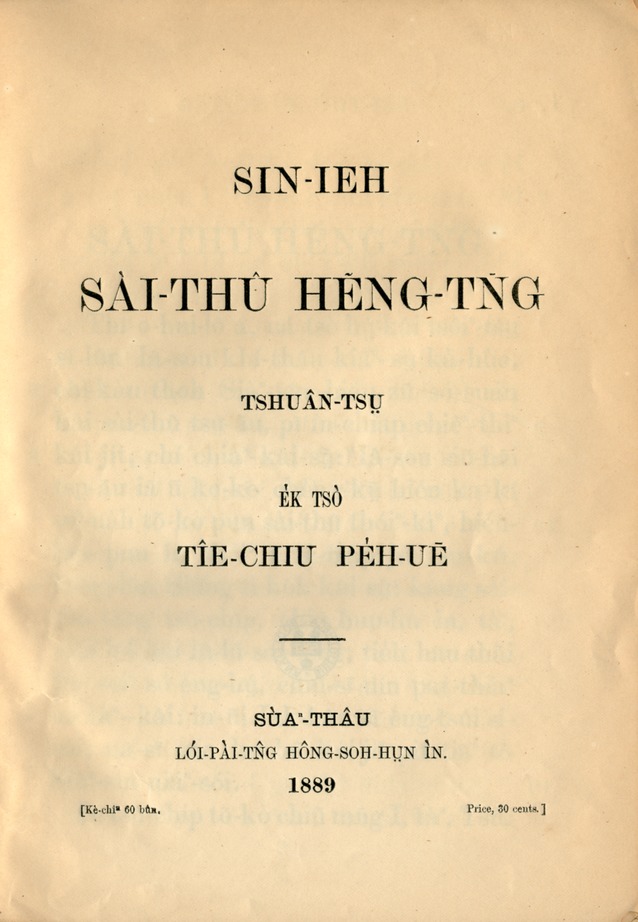
This is a translation of the Acts into the dialect of Swatow (Shantou 汕頭), a coastal city at the eastern end of Guangdong Province, typeset and published in 1889:

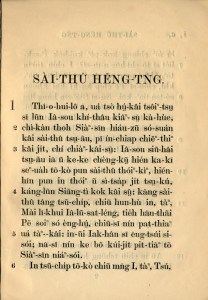
Sinica 6162

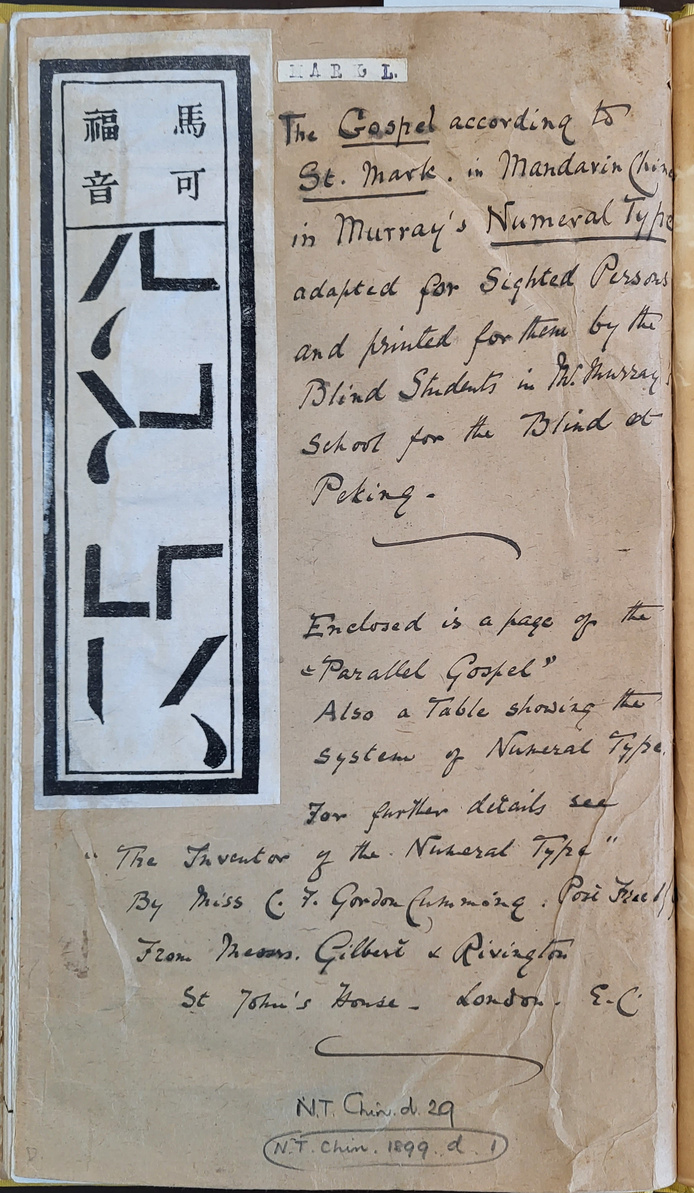
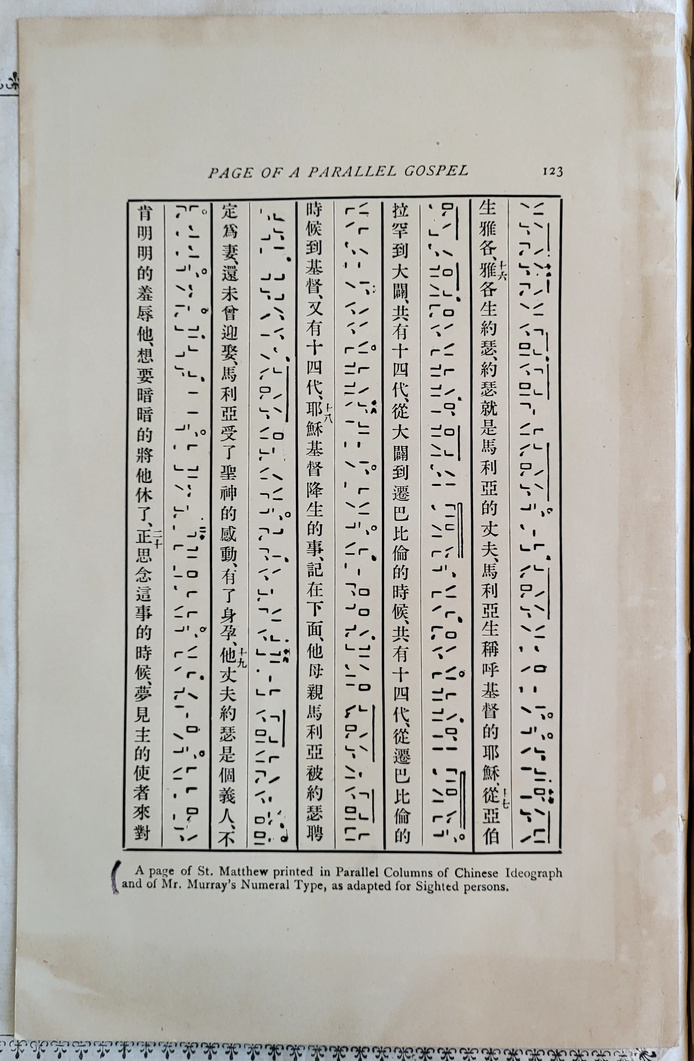
William H Murray (1843-1911), deeply moved by the fate of the blind in China, developed a Braille system based on numerals which enabled blind people to learn to read in a matter of weeks and used it to produce Bibles, hymnals, and other books.

This edition of Mark published in 1896 is a representation of his system in print – I don’t know if it’s a unique example, or whether there are other editions of this kind; I think the phenonemon deserves its own study:
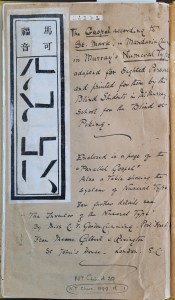
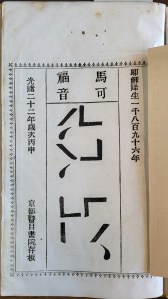
N.T.Chin.d.29

Finally, this very interesting edition came to light as I was going through the collection. It isn’t Chinese, and is an example of how Library books in non-roman scripts were often inappropriately shelfmarked so that they lay unnoticed and unidentified, sometimes getting lost for centuries. It’s actually in Japanese, but has a Chinese shelfmark. It’s a translation of St Luke’s gospel by Bernard Jean Bettelheim (1811-1869) which was blockcut in 1855. The text is in kambun 漢文, and each section is followed by a translation into Japanese expressed in katakana カタカナ:
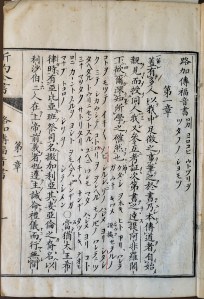
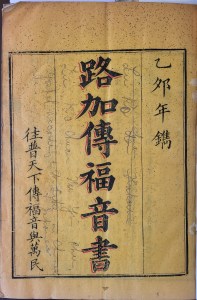
N.T.Chin.d.4


1. Tedder, Henry Richard: E.W.B. Nicholson (Bodley’s librarian, 1882-1912): in memoriam. Aberdeen: Aberdeen University Press, 1914. Also Wikipedia
2. Wheeler, George William: Bodleian press-marks in relation to classification. Bodleian quarterly record 1:10 (1916), 280-292; 1:11 (1916), 311-322.
3. Heaney, Michael: The Bodleian classification of books. Journal of librarianship and information science 10:4 (1978), 274-282.
4. Darlow, T.H. & Moule, H.F.: Historical catalogue of the printed editions of Holy Scripture in the library of the British and Foreign Bible Society. Vol.II, Polyglots and languages other than English. London: Bible House, 1911.
5. Spillet, William Hubert: A catalogue of scriptures in the languages of China and the Republic of China. London: British and Foreign Bible Society, 1975.

Collotype

23 February 2024

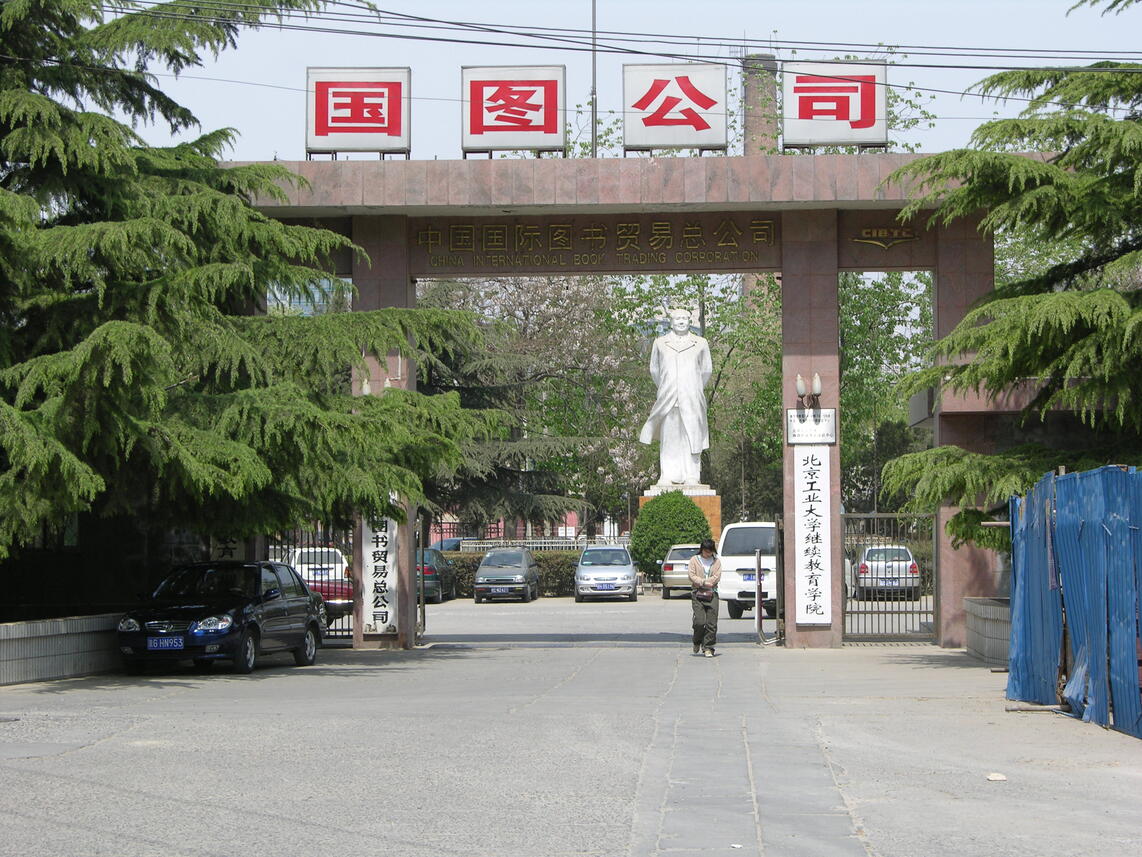
It was only following the appointment of Joshua Seufert in 2012 that I was able to devote all my time to the Bodleian Library’s so-called “special” collections of Chinese materials; before that I worked mostly on acquiring modern materials, both printed and later electronic. Our principal supplier was CIBTC (China International Book Trading Corporation 中国国际图书贸易集团公司), who hosted most of my visits to China.

I was usually looked after by Wang Tong 汪彤 and later Zhu Min 朱敏, who both developed a very good sense of what interested me, and took me to places that would have been inaccessible without their help. I can’t thank them enough for their hospitality over the years, and for showing me some of the most beautiful and impressive sights that I’ve ever seen.

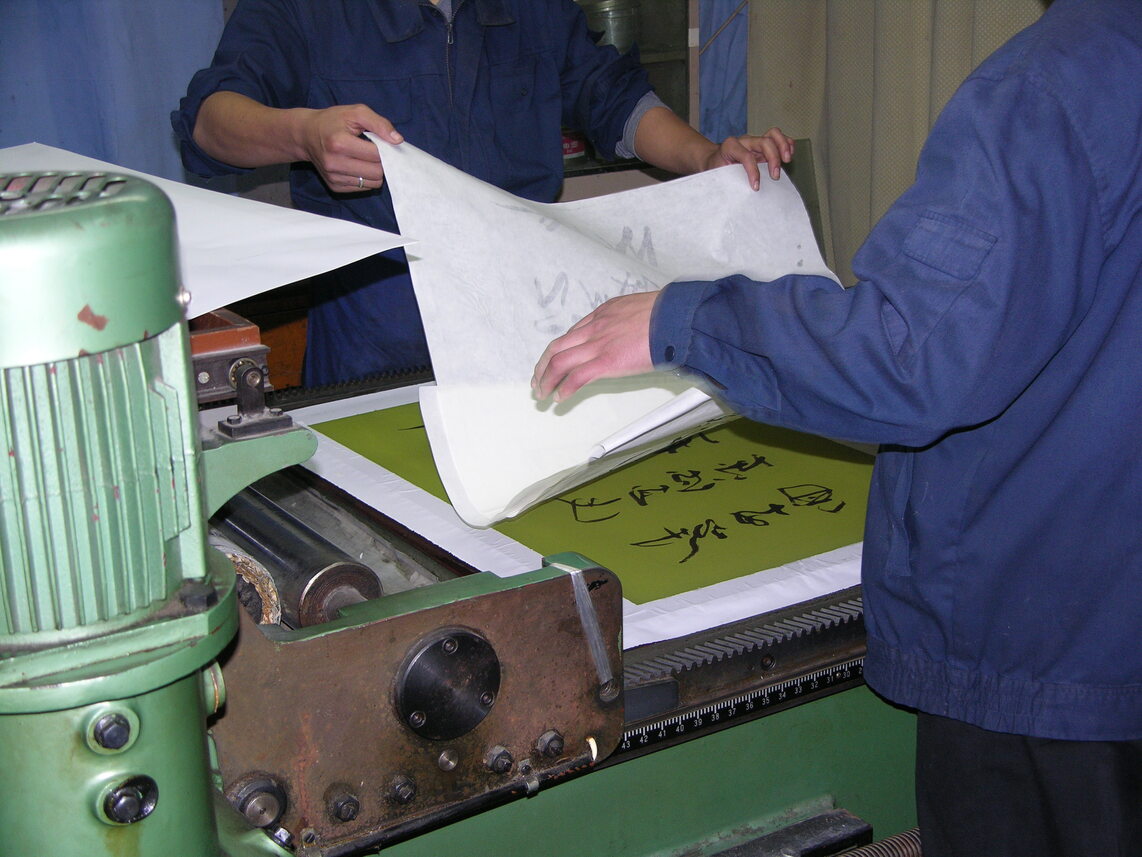
A particularly memorable trip was the one I made in April 2006, which included a visit to Wenwu Chubanshe 文物出版社 in the centre of Beijing. There I saw what I was told was the last remaining printing operation within the walls, a collotype process using a rather old machine.

Here is the complete collection of the pictures that I took on the day of my visit, Tuesday 25 April 2006.

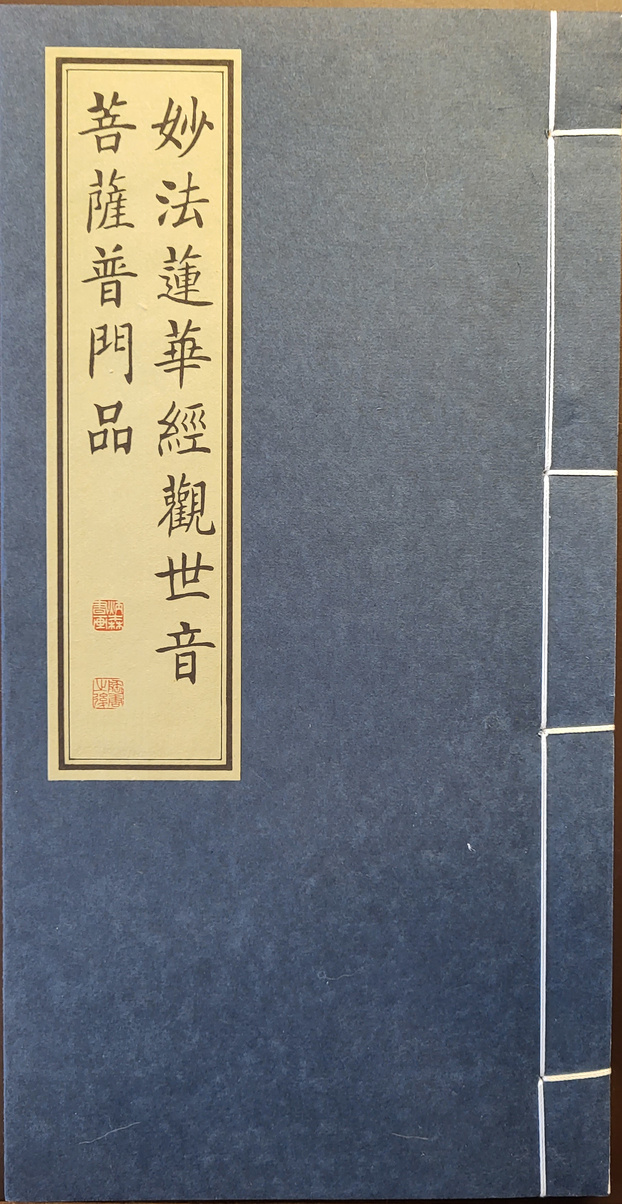
I don’t know what was being printed when I took these pictures, but clearly it is calligraphy and is nothing more than solid black ink on white paper. The same goes for a Buddhist scripture that had been printed on the press earlier in the year for a temple in Tianjin, of which I was given a copy as a memento. I subsequently gave it to the Bodleian and catalogued it as follows:

妙法蓮華經觀世音菩薩普門品 一卷 / (姚秦釋)鳩摩羅什譯
2006年北京文物出版社珂羅版印本
線裝1冊 : 圖 ; 34公分
天津大悲禪院敬印
Sinica 6004

A few more specimen pages 書影 from this edition are attached to its record in the Serica Project.

These pictures have led me to take another look at collotype printing, of which there are some classic examples in the Bodleian collection. I’m ashamed to admit that when I first catalogued them, I dismissed them as nothing more than early versions of what I was currently acquiring in spades: photolithographic reproductions of Chinese editions, many of them illustrated.

I will not pretend to understand the process of collotype printing in any detail. There is an excellent Wikipedia entry on the subject, and it is adequately summarised in the opening words of T.A. Wilson’s book The practice of collotype (1935):

“The collotype process is a photo-mechanical method of printing with ink from the plane surface of a photographic film. It is a process which is capable of producing prints of great beauty, prints that are soft in tone, continuous in gradation, and with remarkable definition of detail. The process combines the arts of photography, printing, and coloring, and provided that a suitable negative be made, any subject can be rendered in collotype. The plates may be printed in a hand press, where the manipulations are extremely variable, or in a power machine, where the dampening, inking, and printing are more or less automatic. The rate of printing of the best collotypes is slow, generally under 500 impressions an hour.” [1]

And in the short account of collotype in his book The technique of prints and art reproduction processes, Jan Poortenaar makes the point that “collotype is unequalled, save by hand-photogravure, among all the photo-mechanical processes for high-class reproduction-work.” [2]

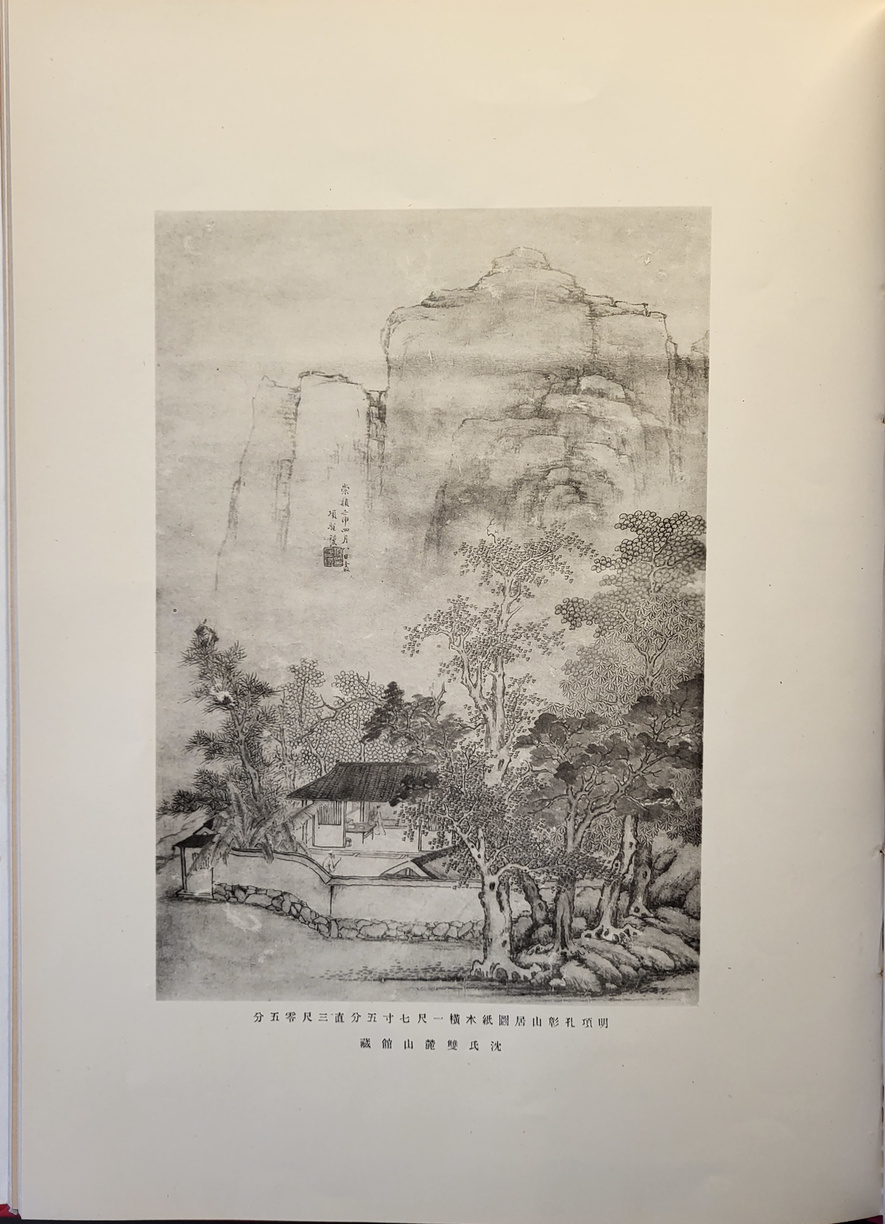
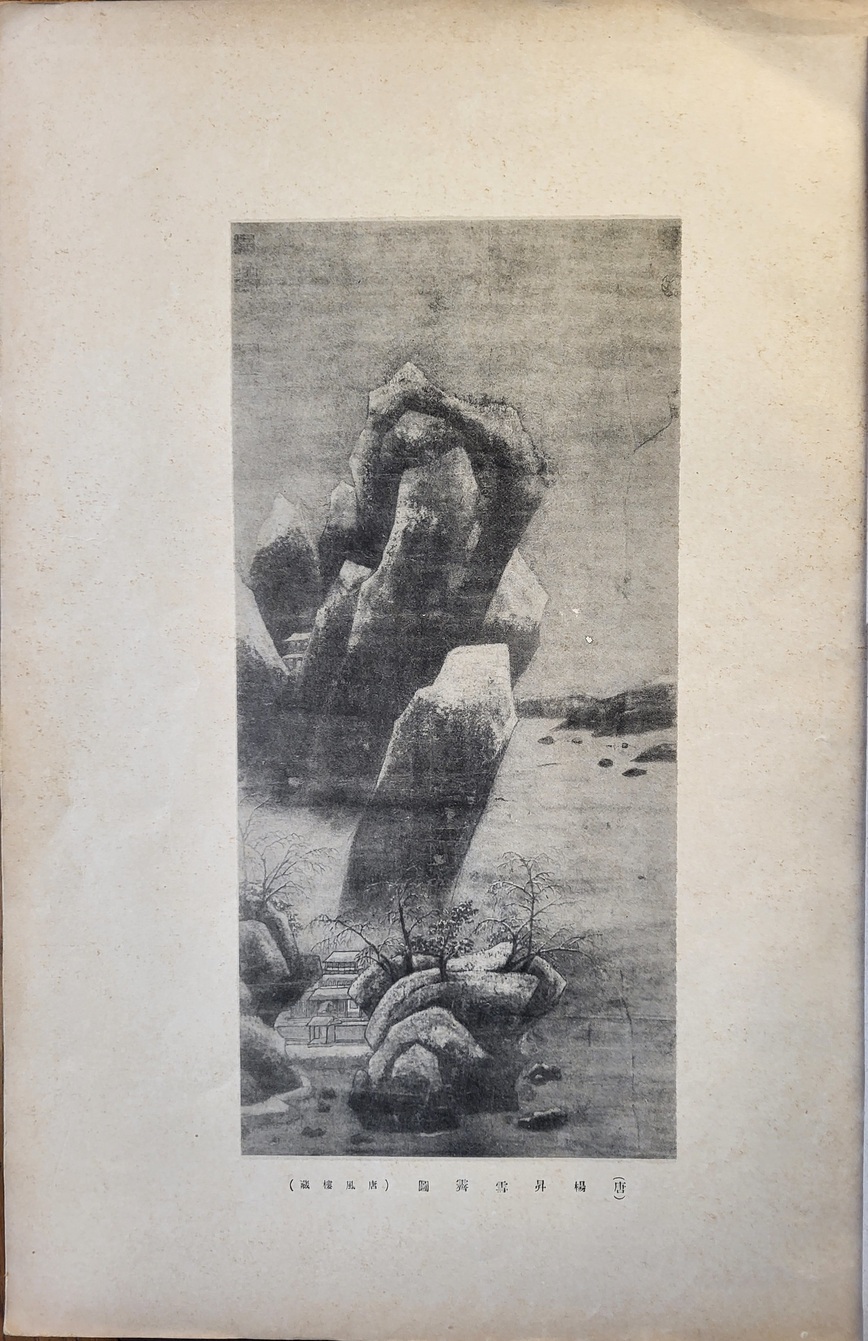
From this it is clear that the examples being printed in Beijing at the time of my visit did not represent the full capabilities of collotype printing. And it is equally clear that when I catalogued two of the earliest Chinese collotype editions in the Bodleian Library, I completely failed to notice how remarkable they were. These two editions are treated in extensive detail by Cheng-hua Wang (Professor of Art and Archaeology at Princeton) in her article New printing technology and heritage preservation: collotype reproduction of antiquities in modern China, circa 1908-1917.

Both were published serially in Shanghai beginning in 1908.

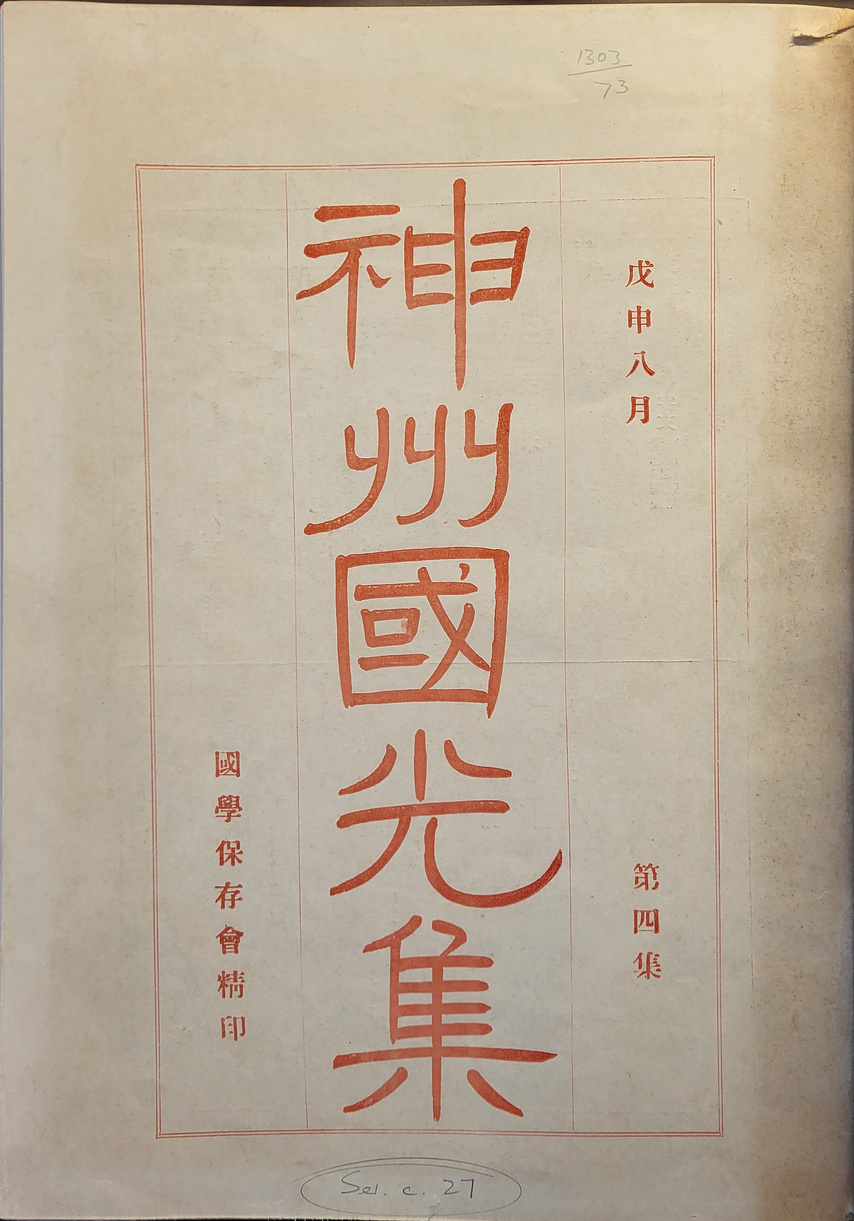
The Bodleian only has a single issue of the first one, Shenzhou guoguang ji, published by Deng Shi 鄧實 (1877-1951):

神州國光集 : 存第四集
清光緒戊申[1908]國學保存會珂羅版印本
洋裝(原平裝)1冊 : 圖 ; 31公分
Sinica 6848

But the Library has rather more of the second one, Zhongguo minghua, published by Di Baoxian 狄葆賢 (1873-1941):

中國名畫. 第一~二十八集 / (民國)美術研究會審定
民國上海有正書局珂羅版印本
木匣1盒(線裝28冊) : 圖 ; 38公分
Sinica 3973
Backhouse 719 存第一~十集. – 線裝10冊 ; 39公分
Sinica 6370 存第二﹑八﹑十集. -線裝3冊 ; 39公分

More illustrations from this work are attached to its record in the Serica Project. And sixteen issues of Zhongguo minghua are in the possession of a French collector who has not only reproduced all the illustrations from them, but has also presented a comprehensive and detailed account of the publication and its background.

The set in the Fung Ping Shan Library in Hong Kong has 40 issues, and is complete. The first copy in the Bodleian (Sinica 3973) preserves a set of the first 28 issues. It is contained in a wooden box (of which there are very few examples in the Bodleian) which suggests that the vendor or owner considered it to be both complete and valuable. Print runs were rather short – Poortenaar says (p.147): “Five hundred good prints may perhaps be obtained; some people speak of a thousand, but then the question arises what are good prints, and what are not.” So to satisfy demand each issue was reprinted many times. Actually these are not strictly reprints, but re-editions, as a comparison of the Bodleian copies will confirm; and in any case, I don’t think storing gelatinous collotype plates and reprinting from them is feasible. Sinica 3973 appears to have been put together in the mid-1920s from copies which had run to as many as 12 editions – here are the details.

It’s always good to discover “landmark” editions in the Library’s collections, and I never expected these two collotype publications to fall into that category. But they do. Professor Wang explains how for the first time they showed to the general public artworks that hitherto had only been available to a privileged few, leading directly to a discussion of what constituted the Chinese national art heritage and how it might be preserved, which was precisely the intention of their publishers, Deng Shi and Di Baoxian.


1. Wilson, Thomas Arden: The practice of collotype (London: Chapman & Hall, 1935), preface. For an earlier account, see Fithian, A W: Practical collotype (London: Iliffe, Sons & Sturmey, 1901).
2. Poortenaar, Jan: The technique of prints and art reproduction processes (London: The Bodley Head, 1933), 146.